Homework in Elementary Music Classes, Really?
I am talking about a simple, powerful way for students to:
Some of the links on this site are affiliate links. If you click on a link and make a purchase, I may earn a small commission at no cost to you.
Are you kidding me? Homework in elementary music classes? Really?
Yes—really! But not the kind of homework you’re probably thinking about. I’m not talking about worksheets, reports, or even note-naming drills.
I am talking about music homework ideas that help students:
- Share what they’ve learned in class.
- Extend their music reading skills at home.
- Build advocacy for your elementary music program.
Now that’s a triple win!
What’s in this post? Click to open the Table of Contents
- Show Evidence of Student Learning
- “Take It Home” Pages
- Frequency of “Homework”
- No Grading Outside of Class
- No Makeup Work
- Create Excitement Around Take it Home Pages
- Handle Take Home Pages as Sheet Music
- Challenge Students to Expand Learning
- Create Sequential Music Resources with Take Home Pages
- Take it Home Pages Help to Build Advocacy for Your Music Program
- Pick Up Your Free Lesson with “Take it Home” Pages
Show Evidence of Student Learning
Parents regularly see what their children are doing in their homeroom classes. Papers come home from spelling, math, reading, and more. But, often, there’s no visible “evidence” of learning from the music room.
That doesn’t mean students aren’t learning. It just means we need a better way to show how students are building elementary music literacy skills in your classroom.
This isn’t about adding worksheets or extra paperwork. It’s not about pulling out pencils and paper every day. It’s about building a system that helps students become confident music readers and share their learning at home.
“Take it Home” Pages
I created a series of music reading lessons that include simple “Take it Home” pages for my classroom. These aren’t traditional homework assignments. They’re simple versions of our music reading songs designed to reinforce skills and be shared at home.
Each page is easy to read and quick to perform. Students practice and complete them in class, then take them home to share with someone in their family.
There’s little to no writing required. The “homework” is simply this: perform the music reading song at home using these three simple steps.
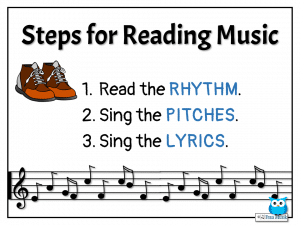
Some of our reading songs are as short as 12 seconds long, so I told students they can complete all three steps of their homework in just 36 seconds. It can be done anywhere—on the way to soccer practice, in the kitchen, or riding in the car.
Three simple steps:
- Read the rhythm.
- Sing the solfege pitches with hand signs.
- Sing the lyrics.
Frequency of “Homework”
Elementary music reading should be integrated into every lesson—but that doesn’t mean students get homework every music day. We practice each lesson for at least three class sessions before completing the Take it Home page and sending it home.
Students need to be able to read and perform the song independently first. Since most students have music once or twice a week, they GET to do music homework about once every other week. And yes—my students would actually cheer when I announced it was a homework night!
👉 10 Tips to Integrate Music Reading into Every Lesson
No Grading Outside of Class
This style of music homework in elementary classrooms doesn’t create extra grading. Students don’t need to return anything.
The best part? I get accurate, frequent checks on each student’s elementary music reading levels.
For more about how to use Take Home Pages as observational assessments, see this post: How to Use Take Home Pages as Music Assessments.
Students take more ownership of their learning when they see their progress. They gain confidence and build real self-esteem as their music literacy grows—and they start noticing connections beyond the music room.
No Makeup Work
Since these elementary music reading activities are done together in class, there’s no makeup work required if a student is absent. I simply mark them as “not present for assessment” in the grade book.
If a student asks about the music homework they missed, I’m happy to send it home with them.
Create Excitement Around Take it Home Pages
Hype it up! My students loved music homework nights. They enjoyed sharing what they learned and showing off their elementary music reading skills.
Some students even created notebooks with all their Take it Home pages, building a personal portfolio over multiple years. One family started this tradition—and others followed.
Sure, a few students never got their “sheet music” home. But the majority did—and they benefited from this simple, effective way to boost music literacy in the elementary grades.
Handle Take Home Pages as Sheet Music
I called our Take it Home pages “sheet music” and taught students how to treat them with care—just like real sheet music.
- Sheet music must never be folded.
- Only use a pencil, never a pen.
- Keep it in a folder or notebook to protect it.
Challenge Students to Expand Learning Beyond the Classroom
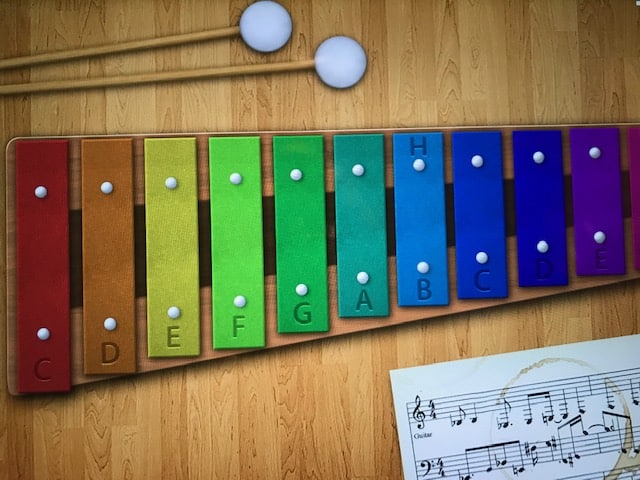
Many of my students had small keyboards, toy xylophones, or other instruments at home they could use to play their elementary music reading songs. Others used iPads or tablets to perform their music using digital instrument apps.
Encouraging students to extend their music literacy in elementary beyond the classroom helped them stay excited and motivated. It also reinforced the idea that music could be part of everyday life, not just the music room.
Create Sequential Music Resources with Take it Home Pages
Sequential lessons which build on prior learning are essential. Each lesson should introduce only one new element at a time. And, each “new” element should be rehearsed with multiple songs. Each concept should be secure before you add additional elements.
If you’re ready to implement Take it Home Pages but don’t have time to create all the materials, check out these ready-made Music Reading Activity Bundles. Each bundle includes:
- PRINTABLE Take it Home pages.
- DIGITAL Easel Activities for elementary music reading practice or assessment.
💡 Need to learn more about Easel Activities?
Check out this post about Easel Activities in the Elementary Music Classroom—it even includes 2 FREE activities to get you started!
How Take it Home Pages Build Advocacy
Music classes are often seen as fun, fluff, or a break from the “real” subjects. But when parents, teachers, and administrators begin to see measurable gains in music literacy in elementary students, they start to view the program differently.
These simple music homework ideas helped shine a light on the real learning happening in my music room. Over time, Take it Home pages became one of the most effective tools I used to build advocacy for music education.
Homework in elementary music classes? You bet! Real learning (and fun) happens in the music room!
Ready to simplify assessment while building real music reading skills?
Browse elementary music literacy lessons and teaching strategies designed for elementary music classes.
Pick Up Your Free Lesson with “Take it Home” Pages
Meet the Author

Terri Lloyd is a former K–5 music educator with more than 30 years of experience teaching elementary music.
Her credentials include:
- Bachelor of Music
- Master of Science in Education with an elementary music focus
- Missouri State Teaching Certificate, Vocal and Instrumental Music, Grades K-12
- Kodály Certification Levels I–III
- Instructional Technology Certificate in Curriculum and Design
Through Frau Musik USA, Terri helps elementary music teachers build students’ music literacy and performance skills with practical lessons and activities grounded in real classroom experience.
She develops music curriculum resources, presents music education workshops, works as a church musician, and K–5 Sunday school teacher. Terri also performs with a local big band, pit orchestras, and at community events.
5 Comments
Comments are closed.