Sign Language for Elementary Music Classroom Management
Some of the links on this site are affiliate links. If you click on a link and make a purchase, I may earn a small commission at no cost to you.
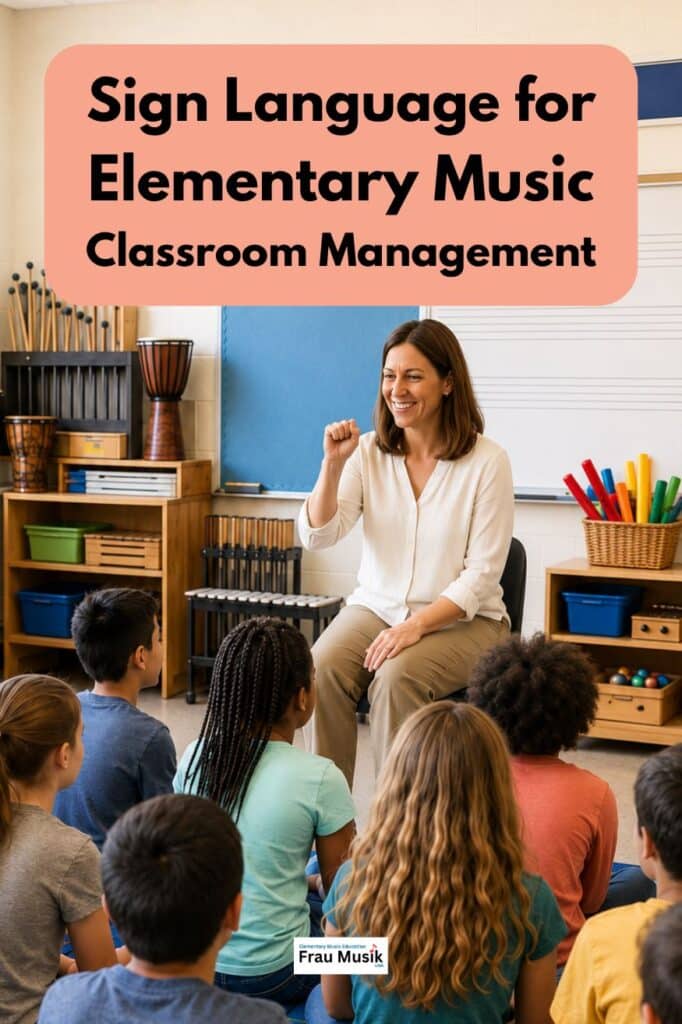
Simple signs can be a helpful classroom management tool in the elementary music classroom. They give students a quiet way to follow directions, respond, and understand routines without adding more teacher talk.
Before you begin teaching signs, it’s important to know that SEE and ASL are not the same. ASL, or American Sign Language, is its own complete language with its own grammar and sentence structure. SEE, or Signing Exact English, follows English word order more closely.
Many signs look the same or very similar, but not always. Check which system your district or school uses so you can be consistent with what students are already learning.
Key Takeaways
Simple signs can be useful classroom management tools in the elementary music room. They help students follow directions, respond quietly, and move through transitions with less teacher talk.
In this post, you’ll find signs to:
- Build a kind classroom climate.
- Give quick yes and no responses.
- Practice manners and respect.
- Help students watch, wait, listen, and stay quiet.
- Manage movement, transitions, and written work.
The Most Importan Sign: Friend
I always told my students that friend was the most important sign we would learn.
Before students learn any other signs, they need to know that our music room is a place where we treat each other with kindness. The sign for friend is a simple way to begin building that classroom climate.
This sign is especially helpful at the beginning of the year, but it’s worth reviewing all year long. Use it when you talk about partners, group work, sharing instruments, taking turns, and listening respectfully while someone else performs.
You might say:
“In this room, we are friends. That doesn’t mean we always agree or that we always do everything perfectly. It means we try to be kind, respectful, and helpful.”
When students understand that friend is more than just a word, it becomes part of the way your classroom works.

Yes and No
Students can answer quick questions without calling out, and you can check for understanding without stopping the flow of the lesson. These signs work well when you ask questions like:
- “Are these patterns exactly the same?”
- “Are we performance ready?
- “Should we try it again?”
Using yes and no as classroom signals gives every student a way to respond. It also helps keep the room calmer because students don’t have to shout answers across the classroom.

Please, Thank You, and You’re Welcome
The signs for please, thank you, and you’re welcome are easy to use every day in the elementary music classroom.
These signs help students practice simple manners without interrupting the lesson. They’re especially helpful when students are passing out instruments, sharing materials, working with partners, or taking turns.
You can also use these signs as quiet reminders. Instead of stopping the class to correct a student, a simple sign for “please” or “thank you” may be all they need.
Over time, these simple signs help build a classroom where students are expected to be respectful, helpful, and kind.


Watch Me and Wait
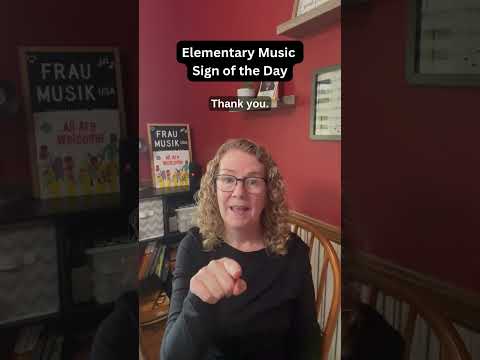
The signs for watch me and wait are very helpful classroom management tools in the elementary music room.
Watch me gives students a quiet reminder to look at the teacher during directions, modeling, or movement begins. This is especially helpful before singing, playing instruments, starting a game, or moving around the room.
Wait is just as important. Students often get excited and want to begin right away, but music class requires careful listening and self-control. A simple sign for wait reminds students to pause, watch, and listen before they start. (This is the perfect senario to combine the signs for stop, watch, and listen.)
These signs can save a lot of teacher talk. Instead of repeating directions, you can use a quiet visual cue to help students get ready for the next part of the lesson.


Listen and Quiet
The signs for listen and quiet are another set of especially helpful signs for the elementary music classroom.
Music lessons are full of sound, movement, instruments, singing, and excited students. These signs give you a quiet way to remind students when it’s time to stop talking and playing and focus their attention.
The sign for listen can be used before students echo a rhythm, identify a melody, follow movement directions, or hear an instrument example. This reminds students that listening comes first.
The sign for quiet is useful when students need to their quiet voices, listen for directions, or settle after an active part of the lesson.
These simple classroom signals help students understand expectations while saving your voice.


Stand Up and Sit Down
The signs for stand up and sit down are simple classroom management signs that you can use many times in one music lesson.
Elementary music students move a lot. We often stand to sing, sit to listen, move to show form, play games, line up, and transition between activities. These signs give students clear visual cues throughout class.
They’re especially helpful during movement activities or when the room is already a little noisy. Instead of raising your voice over the class, you can use the signs for stand up and sit down to guide the next step.
Over time, students learn to watch for signs and transitions can become smoother and faster.


Stop and Freeze
The signs for stop and freeze are important classroom management signals in the elementary music room.
Music lessons often include movement, games, instruments, and active listening. When students are excited, a clear visual cue can help them stop safely and quickly without the teacher needing to raise their voice.
Use stop when you need students to end an action or activity. This might be after playing instruments, moving around the room, singing, or working with a partner.
Use freeze when students need to stop their bodies right away and hold their position. This is especially helpful during movement activities and music games.
When these signs are practiced regularly, students learn to respond quickly. That makes transitions smoother and helps keep active music lessons safe and focused.


Try Again and Show Me
The signs for try again and show me are perfect tools for building a growth mindset in the elementary music classroom.
Music learning takes practice. Students don’t always sing the melody correctly, play the rhythm accurately, or remember the next step in a movement activity the first time. These signs give you a positive way to encourage students without making mistakes feel like a big deal.
Use try again when students need another chance to echo a pattern, sing a phrase, play a rhythm, or follow a direction. It keeps the focus on practice instead of perfection.
Use show me when you want students to demonstrate what they know. They might show you a hand sign, perform a rhythm pattern, demonstrate a movement, or sing a pattern.
Together, these signs help students understand that learning music is a process. We listen, we practice, we try again, and little by little, we get better.


Write Your Name
The sign for write your name is a simple classroom signal that can save a lot of time.
Elementary music teachers often see hundreds of students each week. When students complete worksheets, listening pages, exit tickets, assessments, or composition activities, it’s easy to end up with papers that have no names.
Teaching the sign for write your name gives students a quick visual reminder before they begin. You can use it as students pick up a paper, get started on an activity, or turn in their work. (I also use Friendly Reminder Songs as we picked up those occasional pencil/paper activities.)
This is a simple routine, but it helps students become more responsible and helps you keep track of student work more easily.
(😊 And, if you forget, they will remind you using sign language.)
Simple Signs Can Make Classroom Management Easier
You don’t need to teach a long list of signs all at once. Start with one or two signs that will help your students right away, then add more as they become part of your classroom routines.
In the elementary music room, simple signs can reduce teacher talk, help students follow directions, and make transitions smoother. They also give students a quiet way to respond, participate, and show what they understand.
Whether you are teaching students to wait, listen, stop, try again, or write their names, these small classroom signals can make a big difference. Over time, students learn to watch, respond, and take more responsibility for their part in the music classroom.
As routines become more efficient and students gain confidence using these visual cues, participation naturally increases because more students are actively engaged, responding, and contributing throughout the lesson.
➡️ See More Elementary Music Classroom Management Ideas
Meet the Author

Terri Lloyd is a former K–5 music educator with more than 30 years of experience teaching elementary music.
Her credentials include:
- Bachelor of Music
- Master of Science in Education with an elementary music focus
- Missouri State Teaching Certificate, Vocal and Instrumental Music, Grades K-12
- Kodály Certification Levels I–III
- Instructional Technology Certificate in Curriculum and Design
Through Frau Musik USA, Terri helps elementary music teachers build students’ music literacy and performance skills with practical lessons and activities grounded in real classroom experience.
She develops music curriculum resources, presents music education workshops, works as a church musician, and K–5 Sunday school teacher. Terri also performs with a local big band, pit orchestras, and at community events.