
Pre-Reading Music Skills + Free Steady Beat Body Percussion Activities
Help students build steady beat skills with body percussion activities for elementary music. Includes free printable pre-music reading movement cards.
Some of the links on this site are affiliate links. If you click on a link and make a purchase, I may earn a small commission at no cost to you.
Before students can read rhythm notation, they need to be able to feel and maintain a steady beat. In my elementary music classroom, steady beat activities were the foundation for developing the pre-reading skills young students need for successful rhythm reading.
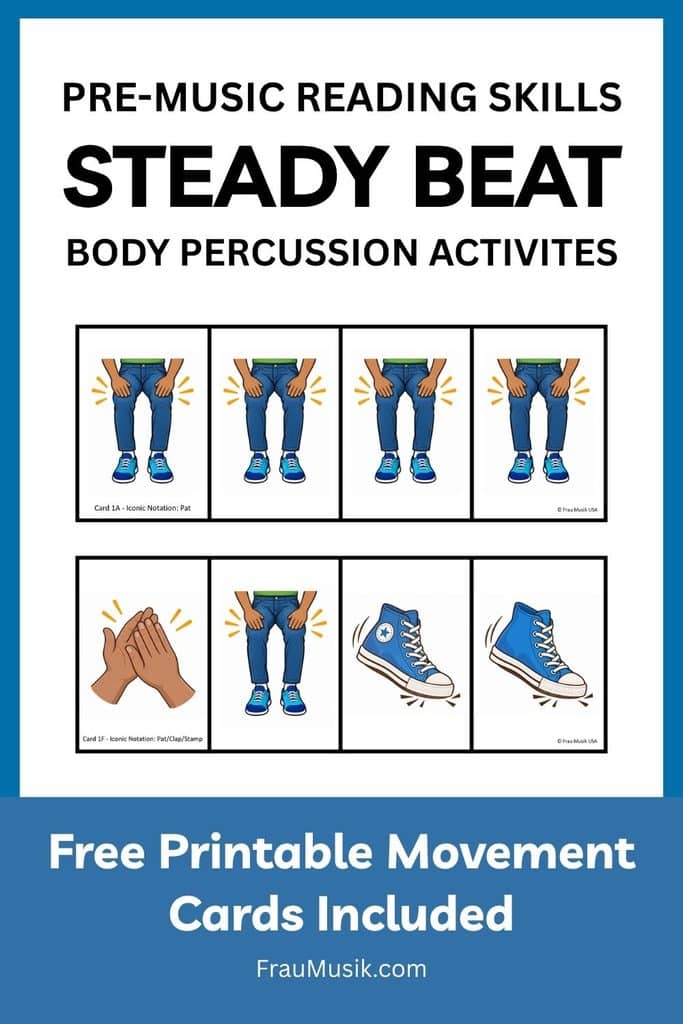
Body percussion makes steady beat practice simple and interesting. Students listen, move, and respond without needing classroom instruments. Begin with easy 4-beat patterns using pat, clap, and stamp. When students are ready, add rest. Practice until students can maintain the beat independently.
Below, you’ll find simple teaching ideas, free Body Percussion Movement Cards, and instrumental music from different genres and cultures that works well for steady beat practice.
Teacher Note: Always preview songs before using them with students. School and district guidelines for music and video content vary.
Start with Simple Steady Beat Body Percussion Patterns
Before adding music, practice the body percussion patterns without accompaniment. This helps students focus on maintaining a steady beat and learning the movements.
Begin with one simple 4-beat pattern. Repeat the pattern at least four times before moving to a new pattern.
For beginning pre-readers, start with:
- Pat both hands on the lap.
- Clap both hands together.
- Stamp one foot.
- Rest with open hands and no sound.
Once students are successful with individual movements, begin combining pat, clap, and stamp within the same 4-beat pattern.
Keep the patterns simple at first. The goal is for students to feel and maintain the steady beat independently, not to perform complicated body percussion.
Free Body Percussion Movement Cards
Want to try a few simple pre-reading steady beat activities before creating your own patterns?
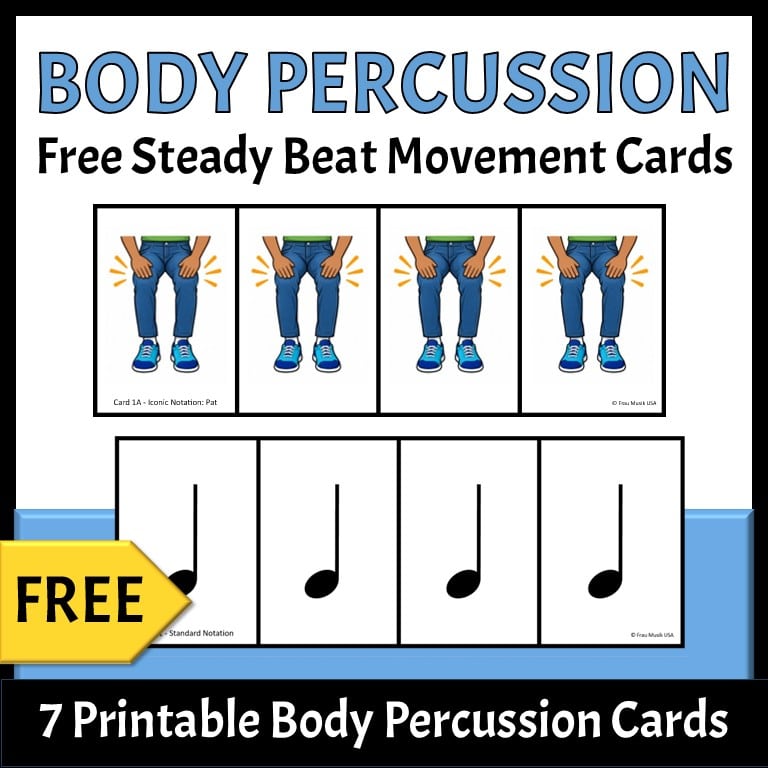
Grab this set of Free Body Percussion Movement Cards to use with the instrumental pieces below. The cards use simple iconic notation and easy 4-beat patterns to help young students feel, follow, and maintain a steady beat before moving on to rhythm reading.
Instrumental Music for Steady Beat Body Percussion
Once students can perform the patterns confidently without music, add an instrumental piece with a clear, steady beat.
Instrumental music works especially well for pre-reading steady beat practice because students can focus on the pulse without being distracted by lyrics. It also gives you an easy way to introduce music from different composers, cultures, styles, and performing ensembles.
Before students begin:
- Practice the body percussion pattern once or twice without music.
- Let them listen for a few measures to find the steady beat.
- Silently cue students when it’s time to begin.
- Repeat the same pattern several times before changing movement cards.
- Stop while students are still successful and engaged.
You do not need to use the entire piece for young students. One or two minutes of focused steady beat practice is usually plenty.
Instrumental Pieces for Steady Beat Practice
The pieces below provide a variety of styles, composers, cultures, and performing ensembles. They have a clear pulse that works well with repeating 4-beat and 8-beat body percussion patterns.
Some selections include changes in tempo, dynamics, fermatas, or musical character. Rather than avoiding these moments, use them as opportunities for students to listen and respond.
Practice the body percussion pattern before starting the recording. Repeat the same 4-beat pattern several times, then change cards as students are ready. When students are ready, combine 2 patterns to create 8-beat patterns.
Keep listening segments short. For young students, 1–2 minutes of focused listening and steady beat practice is usually enough. Many orchestral works are much longer, so choose a short excerpt rather than expecting students to listen to the entire piece in one sitting.
Orchestral & Classical Music
- Surprise Symphony, Movement II – Joseph Haydn
Listen on YouTube (6:15)
The steady pulse makes this a good beginning selection. The unexpected dynamic changes also give students an opportunity to listen for soft and loud while maintaining the beat. (Use a short excerpt.)
- On the Trail from Grand Canyon Suite – Ferde Grofé
Listen on YouTube (7:19)
Freeze during the opening donkey “hee-haw” sounds. Begin the body percussion pattern when the steady beat settles in. Listen for the accelerando as the donkey travels down the trail and the ritardando as it slows down. The “hee-haw” returns throughout the piece and provides a natural place to pause and listen. (Use a short excerpt.)
- Ballet of the Unhatched Chicks from Pictures at an Exhibition – Modest Mussorgsky
Listen on YouTube (1:35)
Use a simple 4-beat pattern and repeat it several times. The short piece includes short fermatas, so students will need to watch and listen carefully for your cue to pause and begin again.
- Parade from Divertissement – Jacques Ibert
Listen on YouTube (1:42)
Begin with a simple steady beat pattern. The piece includes two short fermatas, so cue students to freeze when the music pauses and begin again when the beat resumes. This is also a good selection for listening to contrasting soft and loud dynamics.
- Gigue from Suite No. 3 in D – J.S. Bach
Listen on YouTube (3:09)
This lively Baroque dance is in 6/8 meter, with two strong beats in each measure. Students will feel the larger steady beat rather than each individual eighth note. Begin with a simple pat or clap pattern and repeat it several times before changing cards.
- Dance of the Reed Pipes from The Nutcracker – Pyotr Ilyich Tchaikovsky
Listen on YouTube (2:20)
Practice the body percussion pattern before starting the recording. Repeat the same 4-beat pattern several times, then change cards as students are ready. The clear pulse and repeated musical ideas make this a good choice for maintaining a steady beat.
- Can-Can – Jacques Offenbach
Listen on YouTube (2:17)
Freeze during the short introduction and begin the body percussion pattern when the steady beat enters, around 0:12. Because the tempo is fast and energetic, choose a simple pattern students already know well. Repeat the pattern several times before changing cards. This piece is a fun choice when students are ready for a faster steady beat challenge.
- Children’s Symphony, Third Movement – Harl McDonald
Listen on YouTube (3:03)
Begin with a simple steady beat pattern and repeat it several times. Students may recognize familiar melodies such as The Farmer in the Dell and Jingle Bells. Listen for changes in tempo and dynamics, and cue students to adjust while continuing to feel the steady beat.
- William Tell Overture, Finale – Gioachino Rossini
Listen on YouTube (2:05)
Freeze during the introduction and begin the body percussion pattern when the strong, steady pulse begins. Because the tempo is quick, use a simple pattern students already know well. This is a good choice for students who are ready for a faster steady beat challenge.
- Moonlight Sonata – Ludwig van Beethoven
Listen on YouTube (5:16)
Use a slow, simple body percussion pattern to match the calm, steady pulse. This piece gives students an opportunity to practice maintaining a steady beat at a slower tempo while listening for the soft dynamics and flowing character of the music. (Use a short excerpt.)
- Eine kleine Nachtmusik, Movement I – Wolfgang Amadeus Mozart
Listen on YouTube (8:38)
Begin after the opening measures once students can clearly feel the steady beat. Use a simple 4-beat pattern and repeat it several times before changing cards. Encourage students to continue maintaining the beat while listening for contrasting loud and soft dynamics throughout the movement. (Use a short excerpt.)
Marches
- The Stars and Stripes Forever – John Philip Sousa
Listen on YouTube (4:42)
Allow students to listen to the introduction before beginning the body percussion pattern. The strong march pulse makes this an excellent piece for steady beat practice. Start with a simple pat, clap, or stamp pattern and repeat it several times before changing cards. (Use a short excerpt.)
- Radetzky March, Op. 228 – Johann Strauss Sr.
Listen on YouTube (3:09)
This march has a clear, energetic beat that works naturally with body percussion. Begin with a simple steady beat pattern, then add more varied movements as students are ready. The familiar clapping tradition associated with this piece also makes it especially fun for steady beat practice.
Traditional Mexican Mariachi
- La Raspa – Traditional Mexican
Listen on YouTube (2:29)
Begin with a simple 4-beat body percussion pattern and repeat it several times while students maintain the steady beat. The lively mariachi style provides a strong, clear pulse and gives students an opportunity to experience music from another cultural tradition.
Ready for More Body Percussion Patterns?
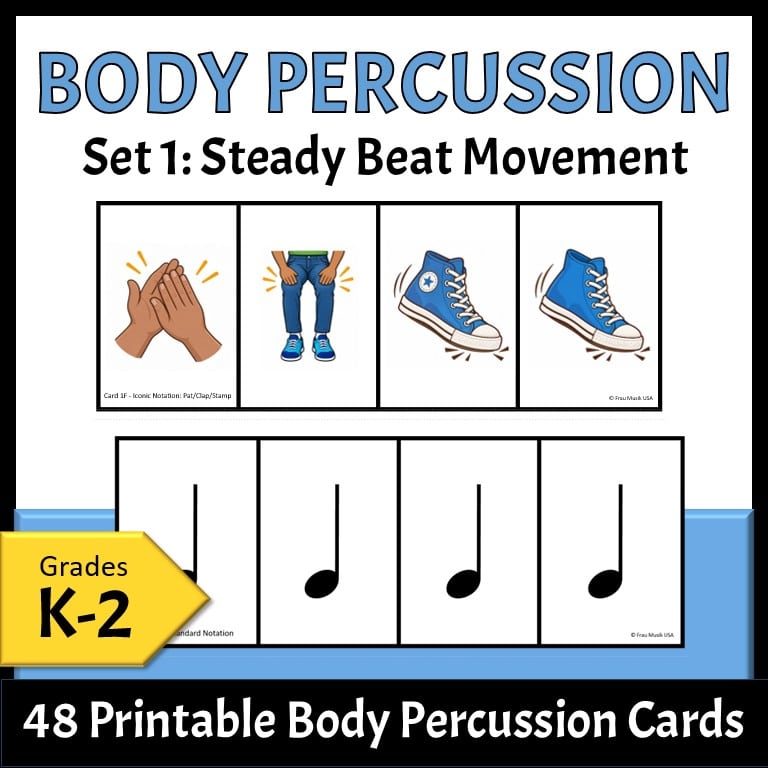
If your students are ready to move beyond the free cards, the complete Steady Beat Body Percussion Movement Cards includes additional pat, clap, stamp, rest, and mixed-movement patterns in both iconic and standard notation.
Start simple and choose more challenging patterns as your students are ready.
Keep Building Your Instrumental Listening Library
Body percussion gives young students something purposeful to do while they listen to instrumental music. They’re keeping the beat, responding to musical changes, and becoming familiar with music they might not hear anywhere else.
Start with one simple pattern and one short excerpt. As students become more confident, change the body percussion pattern, combine two cards into an 8-beat sequence, or listen for changes in dynamics, tempo, and form.
And remember, you don’t have to use the entire piece. One or two minutes of focused listening and successful movement can be just right for young musicians.
Related Posts:
Meet the Author

Terri Lloyd is a former K–5 music educator with more than 30 years of experience teaching elementary music.
Her credentials include:
- Bachelor of Music
- Master of Science in Education with an elementary music focus
- Missouri State Teaching Certificate, Vocal and Instrumental Music, Grades K-12
- Kodály Certification Levels I–III
- Instructional Technology Certificate in Curriculum and Design
Through Frau Musik USA, Terri helps elementary music teachers build students’ music literacy and performance skills with practical lessons and activities grounded in real classroom experience.
She develops music curriculum resources, presents music education workshops, works as a church musician, and K–5 Sunday school teacher. Terri also performs with a local big band, pit orchestras, and at community events.