Musical Instrument Games for Elementary Music – Printable Playing Cards
Musical instrument games for elementary music using printable playing cards. Perfect for centers, sub plans, and review activities.
Some of the links on this site are affiliate links. If you click on a link and make a purchase, I may earn a small commission at no cost to you.
Need fun ways to review instrument families in elementary music?
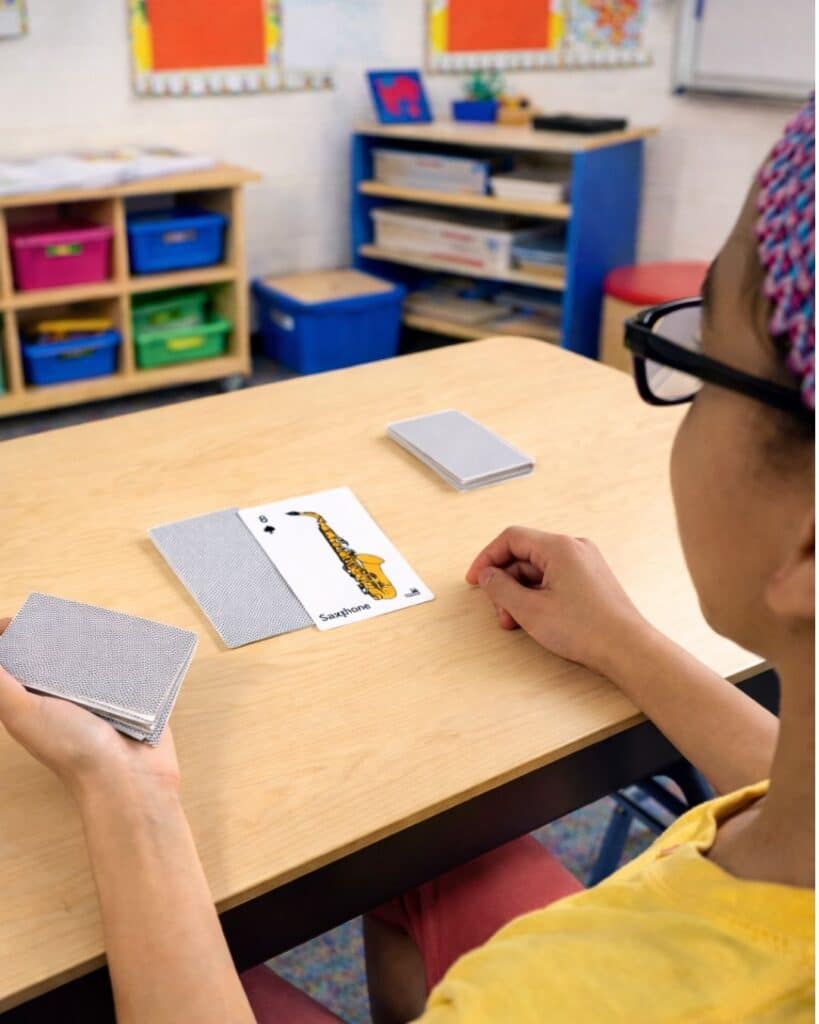
Printable musical instrument playing cards are a simple way to add more interaction to centers, partner work, small group review, and music sub plans. A helpful feature is that you may print cards with or without instrument names. This makes it easy to add support or increase the challenge.
In this post, I’m sharing practical ways to use them in your elementary music classroom.

Why Use Musical Instrument Playing Cards in Elementary Music?
When students are learning instrument families, they need repeated practice seeing, naming, sorting, and discussing instruments. Printable playing cards make that practice easier to manage.
These kinds of musical instrument games for elementary music are helpful because they can be used for:
- Elementary music centers.
- Partner activities.
- Small group review.
- Fast finisher tasks.
- Music sub plans.
- Easy whole-class games.
Once printed (and laminated), they can be used again and again for years to come.
Note: If you ever lose a card, just reprint it.
A Helpful Differentiation Option
One of the most useful features of these cards is the option to print them with instrument names or without instrument names.
That means you can choose the version that best fits your lessons.
Print the Cards With Instrument Names
The labeled version is helpful when students are still learning instrument names and families. It gives them built-in support and makes the activity more accessible.
This version works especially well for:
- Introducing instruments.
- Guided learning.
- Partner work.
- Younger students.
- Music sub plans.
Print the Cards Without Instrument Names
The unlabeled version gives students a chance to rely on visual recognition instead of printed support. This adds challenge and helps students show what they really know.
This version works well for:
- Independent practice.
- Review games.
- Assessment.
- Older students.
- Visual identification activities.
Use Both Versions Together
Using both versions together opens up even more possibilities.
You might:
- Match labeled cards to unlabeled cards.
- Use one version as a self-check.
- Differentiate within the same class.
- Start with names and move to no names later.

These are important skills in the elementary music classroom, especially when students are learning to identify brass, woodwind, string, and percussion instrument families.
Note: Print differentiated decks with different color card backs to easily keep them separated.
10 Ways to Use Musical Instrument Playing Cards in Elementary Music
1. Sort by Instrument Family
This is one of the easiest ways to begin. Students sort the cards into instrument families:
- Brass.
- Woodwind.
- String.
- Percussion.
This works well as an elementary music center or partner activity. It also gives a quick picture of which students can already identify instruments and which ones need more practice.
For differentiation, students can sort the labeled cards first and then try the version without names.
2. Play a Matching Game
Students can match cards in several ways depending on the grade level.
- Play “Go Fish.”
- Match instruments from the same family.
- Match labeled cards to unlabeled versions of the same instrument.
This is a simple way to turn instrument review into a musical instrument game for elementary music class.
3. Use the Cards to Play “Memory”
Split one deck by card suits (hearts, diamonds, spades, clubs). This creates 4 smaller sets. Let students play Memory.
This is a good option for centers because the directions are simple and students can work independently or with a partner. You can also adjust the difficulty by deciding what counts as a match.
For example, a match could be:
- Two cards of the same instrument.
- An instrument in the same family.
- Any card with a conductor “wild card.”
4. Play Guess My Instrument
Give clues and have students identify the correct card.
- This instrument is part of the brass family.
- This instrument has strings and is played with a bow.
- This instrument uses a slide.
- This instrument is struck or shaken.
This works well for whole-class review and helps strengthen music vocabulary at the same time.
Note: Keep a deck handy as a quick time-filler after your lesson is finished.
5. Use Them for Partner Quiz Practice
Give partners a small stack of cards. One student shows a card, and the other student names the instrument and tells its family. Then they switch.
This is a simple, low-prep review game that gets students talking about instruments.
Use the version without names to challenge students.
6. Turn It into a Four Corners Game
Label each corner of the room with an instrument family. Show a card, and students move to the corner that matches the correct family.
This adds movement and helps keep instrument families top-of-mind. It’s especially useful when students need a quick change of pace.
7. Set Up a Scavenger Hunt
Place cards around the room. Students find them and record the instrument name or family on a recording sheet.
This works well as an active elementary music activity and can be used as a review before an assessment.
You can make it easier or harder depending on which version of the cards you print.
8. Give Small Groups a Card Challenge
Give a small group a mixed stack of cards and a task such as:
- Sort the cards as quickly as possible.
- Separate the labeled cards from the unlabeled cards. Use one set to check the other.
- Choose your favorite instrument from each family. Explain why.
- Choose your one overall favorite instrument. Explain why.
This encourages discussion and helps interest students in your school’s band and orchestra programs.
9. Keep Cards Ready
Keep cards easily accessible when you have a few minutes.
- End of class.
- Change of schedule.
- Indoor recess.
10. Add Them to Music Sub Plans
This is one of the most useful ways to use printable music playing cards.
Because the cards are easy to understand, they work well for music sub plans. A substitute can use them for sorting, matching, partner quizzes, or simple review games without needing a lot of musical background knowledge.
The labeled version can be especially helpful for sub plans because it gives students built-in support. The version without names is useful when you want the activity to be more independent or more challenging.
That makes them a strong option for low-prep sub activities in the elementary music classroom.
Why Printable Musical Instrument Games Are So Useful
Printable card games are helpful because they are flexible, easy to use across multiple grade levels, and useful year after year.
They can be used for:
- Elementary music centers.
- Small groups.
- Partner work.
- Whole class review.
- Sub plans.
- Fast finishers.
- Indoor recess.
For teachers who want practical elementary music games that can be reused all year long, printable playing cards can fill a lot of needs.
Music Playing Card Decks to Check Out
If you like using printable music playing cards, below are more decks that work well in elementary and middle school music classrooms.
- Musical Instruments
- Music Symbols: Notes, Rests, and Clefs.
- More Basic Music Symbols.
- Pioneers of Jazz.
- Master Composers.
Bonus: Editable Playing Cards Template
The bundle also includes an editable playing card template to create your own custom decks for the exact concepts you teach.
Take a peek at the bundle: Printable Music Playing Cards Bundle
Final Thoughts
If you’re looking for fun musical instrument games for elementary music, printable playing cards are a simple way to make your lessons more interactive.
The option to print the cards with instrument names or without instrument names makes them even more useful. You can provide support when needed or increase the challenge when students are ready.
They help students practice instrument names, identify instrument families, and stay involved through hands-on music games. They also work well for centers, partner activities, and music sub plans.
Need more easy elementary music games, centers, and sub activities?
Check out my Printable Music Playing Cards Bundle on TPT.
More posts you might like:
Meet the Author

Terri Lloyd is a former K–5 music educator with more than 30 years of experience teaching elementary music.
Her credentials include:
- Bachelor of Music
- Master of Science in Education with an elementary music focus
- Missouri State Teaching Certificate, Vocal and Instrumental Music, Grades K-12
- Kodály Certification Levels I–III
- Instructional Technology Certificate in Curriculum and Design
Through Frau Musik USA, Terri helps elementary music teachers build students’ music literacy and performance skills with practical lessons and activities grounded in real classroom experience.
She develops music curriculum resources, presents music education workshops, works as a church musician, and K–5 Sunday school teacher. Terri also performs with a local big band, pit orchestras, and at community events.