
How to Facilitate Orff Activities with Interactive Xylophone Templates
Learn how to facilitate Orff activities using interactive xylophone templates with practical strategies to support elementary music Orff activities, improve accuracy, and reduce student frustration with barred instruments.
Some of the links on this site are affiliate links. If you click on a link and make a purchase, I may earn a small commission at no cost to you.
Orff activities help students build music reading and performance skills while encouraging creativity and collaboration. However, facilitating Orff activities (especially on barred instruments) can be time-consuming and frustrating for students and teachers.
Interactive xylophone templates provide a clear, visual way to support Orff instruction. By helping students internalize patterns before they play, these templates streamline rehearsals, improve accuracy, and increase student confidence.
These visual tools support elementary music Orff activities by helping students prepare patterns before playing barred instruments.

What Are Interactive Xylophone Templates?
Interactive xylophone templates are visual representations of barred instruments that can be displayed digitally or printed for hands-on use. These templates show the instrument layout from the performer’s point of view and allow teachers to show only the bars needed.
This set of templates includes:
- Xylophone and metallophone/glockenspiel templates.
- Layouts in standard Orff instrument keys of C, F, G.
- Simple toggling options to “remove” bars and match any pitch set.
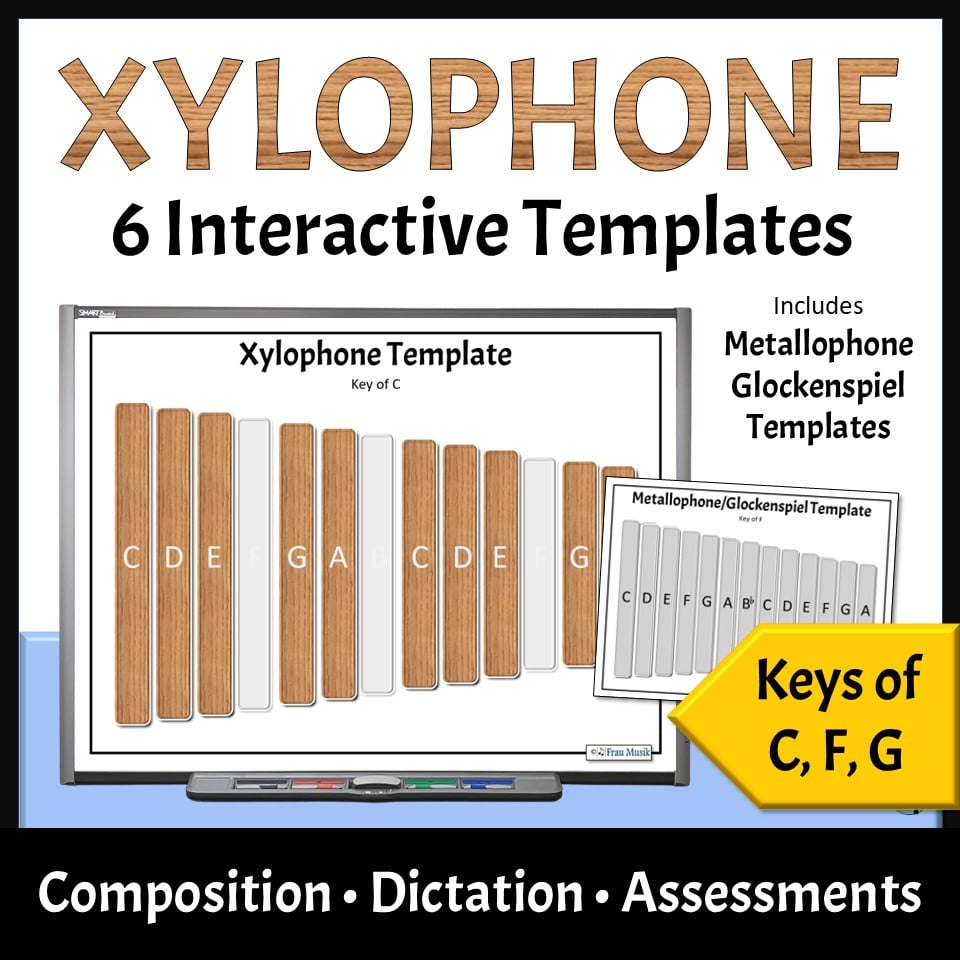
Note: These templates do not make sound. They are designed strictly as visual tools to support learning and rehearsal.
“Air Play” with Interactive Xylophone Templates
Air play practice allows students to rehearse melodic patterns physically and visually before playing on real instruments. This short practice step dramatically improves accuracy and student confidence.
- Sing the pitch names in rhythm.
Have students sing absolute pitch names (A, B, C) or solfege, depending on your focus and how your instruments are labeled. - Display an instrument template on the classroom whiteboard.
Tap to turn over the bars not used in the song or pattern. - Teacher models the pattern.
Using mallets and proper sticking, the teacher points to each bar on the template while students sing the pitch names. - Students air play while the teacher demonstrates the pattern again.
Students use their fingers as mallets and point to the bars on the whiteboard while singing the pitch names. - Air play using real instruments.
Students hover their fingers over the actual bars (or play gently with their fingers) while singing the pitches. - Sing and play.
Once students are secure, they sing and play the pattern on their instruments. Lyrics can be added when appropriate.
This air-play process is especially helpful when facilitating Orff activities with barred instruments in large or mixed-ability elementary music classes.
More Ways to Use Interactive Xylophone Templates
Interactive xylophone templates are flexible tools that can be used in many ways throughout Orff lessons.
Instrument Setup
Display the template while students set up their instruments. Turn over the bars students should remove so everyone sets up correctly the first time.
Paper Practice
Print copies of the xylophone or metallophone slides on heavy cardstock and laminate them. Students who are unable to play their instrument appropriately may play a paper instrument. Or, you can print enough for the entire class to practice.
Centers and Rehearsal Stations
Use printed or digital templates as a rehearsal station or center.
For a more complete look at planning and facilitating Orff lessons, see this overview of 8 Simple and Effective Ways to Teach Music Orff Activities.
A Note About Classroom Expectations
Clear expectations are essential when working with barred instruments. Interactive templates also support classroom management by giving students a productive alternative when instruments need to be removed.
If a student does not follow expectations:
- Remove the instrument immediately.
- Have the student continue participating using body percussion or a paper xylophone template.
- Explain briefly that positive participation earns the instrument back.
Do NOT allow students to interrupt class by playing out of turn on purpose or making noise. Never allow a student to mistreat an instrument.
Ensure all students understand your expectations before they play instruments.
Why Interactive Xylophone Templates Work
When students can see and hear the pattern, practice it physically, and internalize it musically, their performances become more accurate and confident. This reduces frustration and supports more successful ensemble playing.
Xylophone templates provide:
- Faster setup and transitions.
- Fewer incorrect notes.
- Improved ensemble playing.
- Reduced frustration for both students and teachers.
These templates don’t replace Orff teaching. They support it by making the process clearer and more student-friendly, even in large classrooms.
Visual Tools Expand Learning Modalities
Facilitating Orff activities doesn’t have to feel frustrating or rushed. Clear visual tools paired with a short air-play routine help students prepare more efficiently, stay focused during rehearsals, and approach performances with confidence.
Interactive xylophone templates support multiple learning modalities by connecting music reading, movement, and sound in a concrete, student-friendly way. They fit naturally into Orff lessons and make complex tasks more accessible for a wide range of learners.
Enjoy the process and have fun making music together.
Looking for more ways to teach Orff activities in elementary music?
See more Orff lesson ideas for elementary music classes.
Meet the Author

Terri Lloyd is a former K–5 music educator with more than 30 years of experience teaching elementary music.
Her credentials include:
- Bachelor of Music
- Master of Science in Education with an elementary music focus
- Missouri State Teaching Certificate, Vocal and Instrumental Music, Grades K-12
- Kodály Certification Levels I–III
- Instructional Technology Certificate in Curriculum and Design
Through Frau Musik USA, Terri helps elementary music teachers build students’ music literacy and performance skills with practical lessons and activities grounded in real classroom experience.
She develops music curriculum resources, presents music education workshops, works as a church musician, and K–5 Sunday school teacher. Terri also performs with a local big band, pit orchestras, and at community events.