“Non-Music” Sub Survival Guide: 5 Engaging Elementary Music Activities for Any Substitute
Looking for elementary music sub plans? These no-prep activities for grades K-5 reinforce music skills even with a non-music substitute.
Some of the links on this site are affiliate links. If you click on a link and make a purchase, I may earn a small commission at no cost to you.
You’re out sick or at a workshop, and your substitute has never taught elementary music. No piano skills. No instrument experience. No idea what “Do-Re-Mi” means.
That’s stressful! Many elementary music teachers worry that sub plans turn into a movie day, or worse, a chaotic class period. But substitute days do not have to mean lost instructional time.
With the right elementary music sub plans, students can continue practicing music vocabulary, music reading skills, and instrument recognition in a calm, structured way.
In this post, I’ll share five engaging elementary music activities that work for any substitute (even with zero musical background).
Build a “Sub Tub” That Actually Works
If you’ve taught elementary music very long, you’ve learned that scrambling at 6:00 a.m. to throw together sub plans is not a sustainable strategy.
A well-prepared Sub Tub gives you peace of mind and keeps your classroom structured, even when the substitute has no music background. The goal isn’t to impress the sub with complex lesson plans. The goal is simplicity and clarity.
What Makes a Sub Tub Effective?
A strong elementary music Sub Tub keeps substitute days structured and purposeful.
Keep K–2 and 3–5 Materials Separate
- One folder for K-2 lessons.
- One folder for Grades 3-5 lessons.
Primary students need highly guided, visual activities. Upper elementary can work more independently.
Choose No-Instrument Activities
Avoid Orff instruments, recorders, or movement games. Plan seated, paper-based, or projected elementary music activities that require no equipment.
Write Clear, Scripted Directions
Assume the substitute has never taught music. Short, direct instructions prevent confusion and behavior problems. For example:
- “Read the directions aloud.”
- “Students may work quietly with a partner.”
- “Collect papers at the end of class (or not).”
Include Answer Keys
Attach clearly labeled answer keys so work can be checked without adding stress for the substitute.
Add Early Finisher Options
Extra word searches, crosswords, coloring pages, or composition sheets prevent downtime and off-task behavior.
A well-prepared Sub Tub reinforces music curriculum goals and ensures students continue learning even when you’re absent.
Add a Simple Tracking Chart to Your Sub Tub
Staple a tracking sheet inside each K–2 and 3–5 folder. Ask the substitute to record:
- Date
- Activity used
- Grade and classes
This prevents repeating the same elementary music lesson too soon.
Some activities, like Musical Instrument Bingo, can be reused later in the year. Others, such as specific worksheets, may be better used only once per class.
Once your Sub Tub system is in place, you can reuse it year after year with only small updates.
Activity #1: Music Word Searches & Crossword Puzzles (Grades 3–5)
For upper elementary sub plans, music word searches and crossword puzzles are a safe and effective choice.
They reinforce music vocabulary while keeping the classroom calm and structured. Most importantly, they require zero musical background from the substitute.
Why They Work So Well
- Clear written directions.
- Independent or partner-friendly.
- No instruments required.
- Built-in accountability with right-or-wrong answers.
Even a substitute who has never taught music can confidently help students complete a puzzle (when they have the answer key).
What Skills Can Puzzles Reinforce?
Music-themed puzzles are perfect for reviewing:
- Musical instruments (band and orchestra instrument families).
- Music symbols (clefs, notes, note values, repeats, coda, etc.).
- Music vocabulary (tempo terms, dynamics, articulation).
This keeps your music literacy sequence moving forward instead of pausing for a “filler” day.
If you want an easy place to start, my Music Word Search & Crossword Puzzles for elementary music grades 3-5 are no-prep and perfect for sub plans.
Activity #2: Treble Clef Note Names Review (Grades 3–5)
If there’s one skill I can confidently leave for a sub day, it’s treble clef note names.
This activity works because substitutes do not need to read music. Students are identifying letter names on the staff, and directions are clear and visual.
Why Treble Clef Note Name Worksheets Work for Sub Plans
- Reinforces music literacy skills.
- Clear written directions.
- Independent or partner-friendly.
- Easy to collect and assess.
Self-Checking PowerPoint Note Name Games
If you have a projector, self-checking games are another excellent option.
- All students may answer on paper, on whiteboards, or in sign language.
- All students are involved all of the time.
- No music knowledge required from the substitute.
For an easy upper elementary option, my Treble Clef Note Name Worksheets and self-checking PowerPoint Games reinforce staff reading and are easy for subs to teach.
Activity #3: Story Songs for Primary Grades (K–2)
For Kindergarten through second grade, story-based singing activities are one of the easiest options for a non-music substitute.
Young students need structure, repetition, and visuals. Story songs provide all three.
Why Story Songs Work for K–2 Sub Plans
- Clear slides or storybooks.
- Predictable, repetitive text.
- Built-in singing and listening practice.
- No instruments required.

Add Simple Accountability
To extend the lesson, include:
- A retell-the-story worksheet.
- A draw-your-favorite-part page.
- A create-your-own-verse activity.
These literacy connections reinforce sequencing and comprehension while still supporting elementary music skills.
Story songs are especially helpful for sub days because they blend music and reading in a way that feels natural. Students stay engaged, routines stay intact, and your primary grades continue practicing singing and listening skills even when you’re not there.
If you need simple primary options, my Story Song Series for K–2 gives substitutes clear slides, built-in repetition, and easy follow-up worksheets that keep young students engaged and learning.
Activity #4: Color, Cut, Compose (Grades K–5)
If you want a creative option that still provides a tight, easy-to-follow structure, composition worksheets are a strong choice for sub plans.
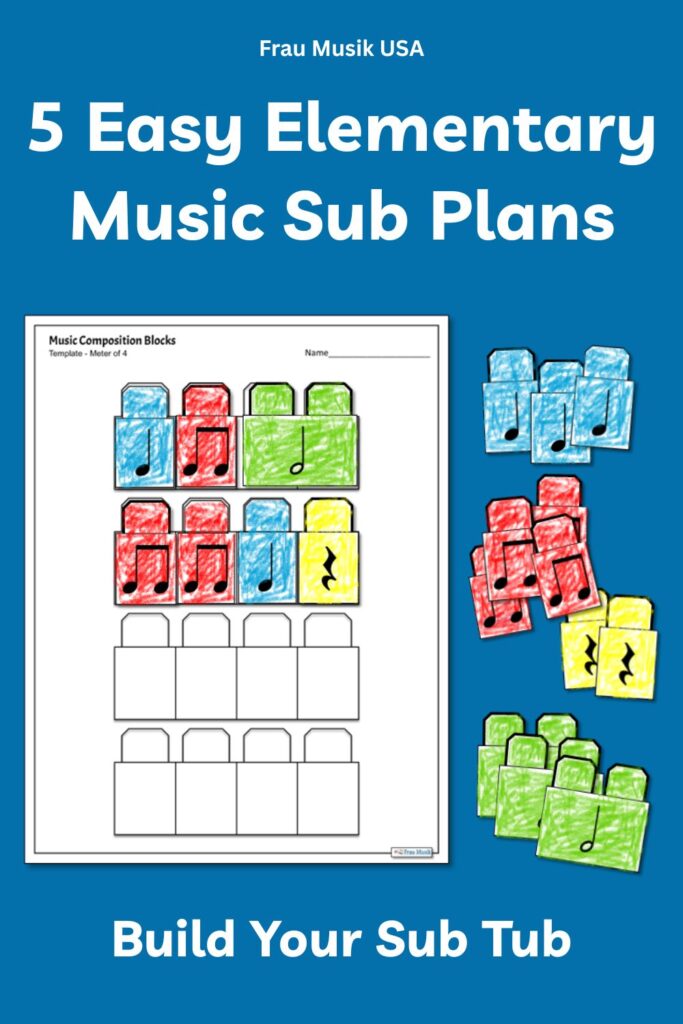
Color, Cut, Compose activities give students hands-on music “writing” practice while templates ensure success.
Why Composition Blocks Work for Sub Days
- Clear visual directions.
- Note blocks are sized to fit templates.
- Quiet, focused work time.
- Differentiated levels for K–5.

Students color all like music symbols the same color and arrange notes and rests to create their own short composition. When they are satisfied with their composition, they glue it to the template.
The substitute’s role is simply to monitor and collect.
How to Keep It Simple for a Non-Music Sub
- Include a finished example.
- A reminder that neatness and effort matter.
- Optional share time if time allows.
Because these worksheets are differentiated, younger students can work at a basic level while upper elementary students write more advanced patterns.
If you want a creative but structured option, my Color, Cut, Compose Worksheets include differentiated, leveled activities for Grades K–5 so every class can work at their own level, even on a sub day.
Activity #5: Learn the Musical Instrument Families (Grades K–5)
If you need strong elementary music sub plans for multiple days, a focused unit on musical instrument families of the orchestra and band is one of the best options.
Instrument study is structured, visual, and highly engaging.
Grades 3–5: Instrument Family Presentations & Guided Notes
Upper elementary students can take a deep dive into instrument families.
- String instruments
- Woodwind instruments
- Brass instruments
- Percussion instruments
Interactive presentations with real instrument photos and performance video links allow students to see and hear each instrument in action.
Why this works for sub plans:
- “Read and present” script included.
- Slides guide the lesson step by step.
- Optional guided notes worksheets keep students accountable.
- Builds listening skills and instrument recognition.
This type of guided lesson is especially helpful during:
- Beginning band or orchestra recruitment season.
- End-of-unit review.
- Multiple consecutive sub days.
Because everything is clearly structured, even a non-music substitute can successfully lead the lesson.
Grades K–2: Instrument Coloring Pages with Audio Links
Primary students need something simpler and more hands-on.
Instrument coloring pages with short descriptions and QR code performance links allow students to:
- See realistic instrument images.
- Hear the instrument sound.
- Connect visual learning with listening skills.
Why this works for sub plans:
- Printable and no prep.
- Simple directions.
- Keeps students seated and engaged.
- Reinforces instrument families in an age-appropriate way.
Add a Game Option: Musical Instrument Bingo
If students have already been introduced to instrument families, a Music Bingo listening game is an excellent review option.
- Strengthens instrument identification by sight and sound.
- Keeps students focused through game-based learning.
- Works for whole-class or small-group review.
- Ideal for upper elementary sub days.
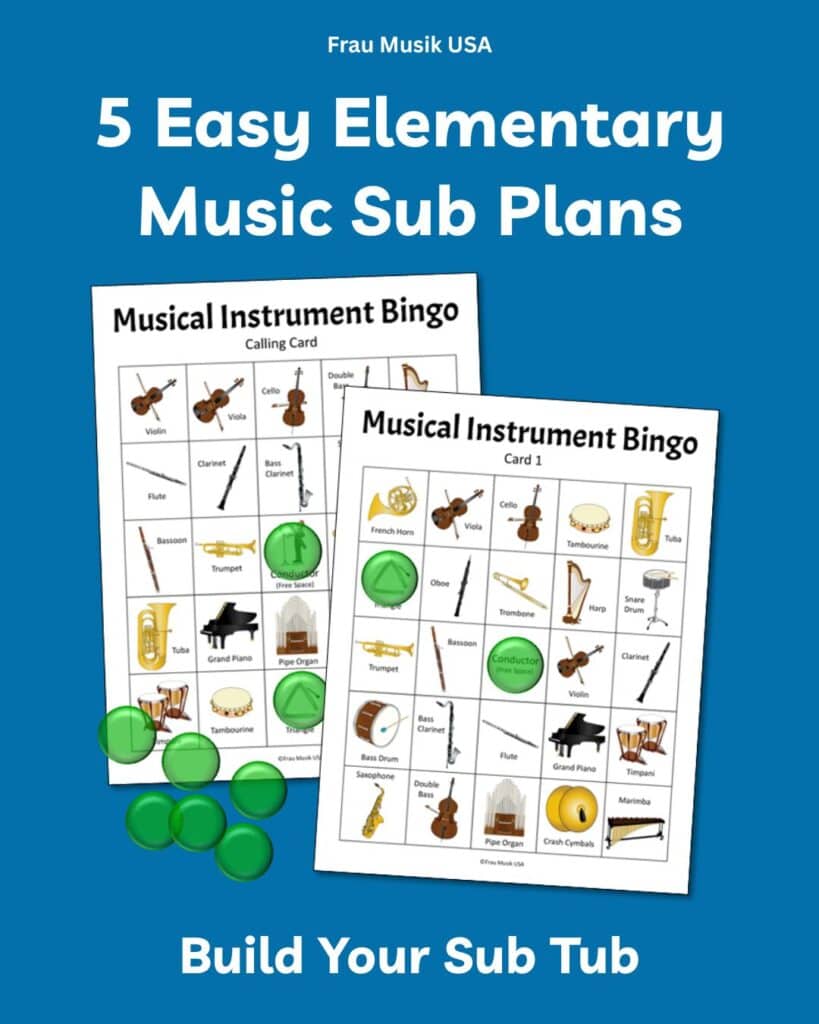
Because online audio clips are provided and directions are clear, substitutes can run the game.
A short instrument unit is perfect when you know you will be gone for more than one day. Students build listening skills, strengthen instrument recognition, and continue meaningful elementary music lessons without needing you in the classroom.
For an easy multi-day option, create an Instrument Unit with these activities:
- Musical Instrument Family Presentations
- Instrument Coloring Pages with Video Links
- Musical Instrument Bingo
These activities give students structured, engaging ways to build instrument recognition and listening skills, even with a non-music substitute.
Why Strong Sub Plans Matter in Elementary Music
Sub days are part of teaching. But they do not have to mean lost instructional time.
When elementary music sub plans reinforce your music curriculum, they send a clear message: real learning happens in the music classroom. And, music learning continues even when the teacher is absent.
A well-prepared Sub Tub helps you meet your curriculum goals.
Closing: Build It Once. Use It for Years.
The key to stress-free sub days is preparation.
Start small:
- A folder of music word searches and crosswords.
- Treble clef note name worksheets.
- A few story songs for K–2.
- Differentiated composition pages.
- An instrument family unit you can pull out anytime.
Once your Sub Tub is built, you will reuse it year after year with only small updates.
If you’re looking for ready-to-use elementary music sub plans, the resources mentioned in this post are designed specifically to make those days easier for you and manageable for any substitute.
Because music learning should continue, even when you’re not in the room.
👉 More Elementary Music Sub Plans
Resources Mentioned in This Post
- Story Song Series (Grades K–2)
- Instrument Coloring Pages with Video Links (Grades K-2)
- Color, Cut, Compose Worksheets (Grades K-5)
- Musical Instrument Bingo (Grades 1-5)
- Music Word Search & Crossword Puzzles (Grades 3–5)
- Treble Clef Music Worksheets for Sub Plans (Grades 3-5)
- Treble Clef Note Names PowerPoint Games (Grades 3-5)
- Musical Instrument Families Unit (Grades 3-5)
Meet the Author

Terri Lloyd is a former K–5 music educator with more than 30 years of experience teaching elementary music.
Her credentials include:
- Bachelor of Music
- Master of Science in Education with an elementary music focus
- Missouri State Teaching Certificate, Vocal and Instrumental Music, Grades K-12
- Kodály Certification Levels I–III
- Instructional Technology Certificate in Curriculum and Design
Through Frau Musik USA, Terri helps elementary music teachers build students’ music literacy and performance skills with practical lessons and activities grounded in real classroom experience.
She develops music curriculum resources, presents music education workshops, works as a church musician, and K–5 Sunday school teacher. Terri also performs with a local big band, pit orchestras, and at community events.